You hear a song, pick up your guitar and try to figure out what chords are being played. Sometimes you get it quickly. Other times, you can spend half an hour trying different chords and still wonder, “Which chord is this?”
That’s where a chord finder can be incredibly useful.
Whether you’re a beginner learning guitar, a piano player trying to understand chord structures, or a songwriter trying to figure out the chords of a song, a good chord finder can save a lot of time.
Try Our Free Chord Finder
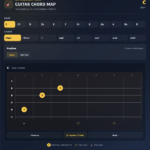
If you’re looking for a simple way to identify and explore chords, try the RhythmCrest Chord Finder below.
Guitar Chord Finder
You can use it to explore chord names and understand how different notes come together to create a chord.
For beginners, this can be much easier than trying to understand complicated music theory first.
What Is a Chord Finder?
A chord finder is a tool that helps you identify or discover chords.
Depending on the tool, you may be able to enter notes, select strings on a guitar, choose piano keys or search for a particular chord.
For example, if you know the notes being played but don’t know the name of the chord, a chord finder can help answer:
“Which chord am I playing?”
This is particularly useful when you’re experimenting on your instrument and accidentally discover a chord that sounds great.
Instead of forgetting it, you can identify it and write down its name.
Chord Finder for Guitar
A chord finder guitar tool is particularly useful because the same chord can have several different shapes on the fretboard.
For example, a C major chord can be played using an open position, but it can also be played higher up the neck using different shapes.
A guitar chord finder can help you understand these positions instead of relying entirely on memory.
If you’re a beginner, however, don’t try to learn every possible shape immediately.
Start with the common open chords and gradually move toward barre chords and more advanced voicings.
Guitar Chord Finder by Sound
One of the most interesting uses of technology is trying to identify a chord simply by listening to it.
This is where searches such as guitar chord finder by sound and guitar chord finder from audio come from.
There are now AI-powered tools that attempt to analyse an audio recording and detect the chords being played.
The basic idea is simple:
Audio → analysis → possible chord progression
However, audio-based chord detection isn’t magic.
A recording may contain bass notes, multiple instruments, effects, suspended notes and other sounds that make identifying the exact chord more difficult.
An AI chord finder from audio online free may therefore give you a useful starting point rather than a guaranteed transcription.
For simple guitar recordings, the results can be much easier to interpret.
Chord Finder From YouTube
Another popular idea is a chord finder from YouTube.
You provide a song or video and the tool attempts to determine the chords being used.
This can be useful when you’re trying to learn a song but can’t find reliable chord information online.
A guitar chord finder YouTube tool can potentially help you identify the progression and then practise it on your own instrument.
But there is an important difference between identifying chords and producing a complete song transcription.
Chord detection can tell you something like:
Am → F → C → G
But it doesn’t necessarily tell you exactly when every chord changes, what inversion is being used or how the guitarist is voicing it.
Chord Finder Online vs Chord Finder App
You don’t necessarily need to install an application to experiment with chords.
A chord finder online can be accessed directly through your browser, which makes it convenient when you’re practising on a computer or phone.
A chord finder app, on the other hand, can be useful when you’re practising with your instrument and want something available on your phone.
Both approaches have their advantages.
For a quick question such as “What chord is this?”, an online tool is often the simplest option.
What Is a Chord Formula?
If you want to understand chords instead of simply memorising them, you should learn about the chord formula.
A chord formula describes the notes of a chord in relation to a scale.
For example, the formula for a major triad is:
1 – 3 – 5
So if you take the C major scale:
C – D – E – F – G – A – B
The 1st, 3rd and 5th notes are:
C – E – G
That’s a C major chord.
This is much more powerful than memorising individual chords because you can use the same formula in different keys.
Common Chord Formulas
Here are a few basic formulas worth learning:
| Chord | Formula |
|---|---|
| Major | 1 – 3 – 5 |
| Minor | 1 – ♭3 – 5 |
| Diminished | 1 – ♭3 – ♭5 |
| Major 7 | 1 – 3 – 5 – 7 |
| Minor 7 | 1 – ♭3 – 5 – ♭7 |
| Dominant 7 | 1 – 3 – 5 – ♭7 |
| Sus2 | 1 – 2 – 5 |
| Sus4 | 1 – 4 – 5 |
Once you understand formulas, chord construction becomes much less mysterious.
What Is a Chord Family?
A chord family is a group of chords that naturally belong to the same key.
For example, in the key of C major, the basic diatonic chords are:
C – Dm – Em – F – G – Am – Bdim
These chords are built from the notes of the C major scale.
This is why certain chords sound naturally good together.
When you understand the chord family, you can start predicting what chord might come next in a song.
Chord Family Chart
A basic major-key chord family chart looks like this:
| Scale Degree | Chord |
|---|---|
| I | Major |
| ii | Minor |
| iii | Minor |
| IV | Major |
| V | Major |
| vi | Minor |
| vii° | Diminished |
For C major, that becomes:
C – Dm – Em – F – G – Am – Bdim
The same pattern works in other major keys.
This is one of the most useful concepts for songwriters because once you know the key, you have a much better idea of which chords are likely to work together.
What Is a Chord Formula Circle?
You may also come across the term chord formula circle.
This is generally used to describe visual ways of connecting chord formulas, keys and harmonic relationships.
It can be particularly useful when combined with the Circle of Fifths, because the circle helps musicians understand relationships between keys and their associated chords.
If you’re already learning music theory, connecting chord formulas with the Circle of Fifths can take your understanding to another level.
Chord Factory: Build Your Own Chords
Think of a chord factory as the idea of building chords rather than memorising them.
Start with a root note.
Then apply a formula.
For example:
C + 1–3–5 = C major
Change the third:
C + 1–♭3–5 = C minor
Add a seventh:
C + 1–3–5–7 = C major 7
Once you understand this process, you don’t have to memorise thousands of chord names.
You can construct them.
Chord Finder Piano
Chord identification isn’t limited to guitar.
A chord finder piano can help you determine the name of a chord when you know which piano keys are being played.
For example, if you play:
C – E – G
the chord is C major.
If you change E to E♭:
C – E♭ – G
you get C minor.
This is why learning the relationship between notes is more useful than simply memorising shapes.
Guitar Chord Finger Position Chart
For guitarists, knowing the theory is only half the battle.
You also need to know where your fingers go.
A guitar chord finger position chart shows you exactly where to place your fingers on the fretboard.
You’ll often see numbers representing the fingers:
- 1 = index finger
- 2 = middle finger
- 3 = ring finger
- 4 = little finger
A guitar chord fingering chart may also show which strings should be played open and which should be muted.
Guitar Chord Fingerings Can Be Different
There isn’t always just one correct fingering for a chord.
A chord can have multiple voicings and positions.
For example, an E major chord has a familiar open position, but the same chord can also be played elsewhere on the neck.
That’s why guitar chord fingerings become more interesting as you progress.
At the beginner level, focus on the easiest and most practical shape.
Later, start exploring different voicings.
Guitar Chord Finger Placement for Beginners
If you’re new to guitar, guitar chord finger placement can be frustrating.
Your fingers may accidentally touch neighbouring strings, causing them to sound muted.
A few simple habits can help.
Keep your fingers curved and use your fingertips to press the strings. Try to place your finger close to the fret rather than directly on top of it.
And don’t squeeze the neck as hard as possible.
You only need enough pressure to make the note ring clearly.
The more you practise, the easier this becomes.
Which Chord Is This?
This is probably one of the most common questions beginners ask.
“Which chord is this?”
If you’re holding several notes on your guitar and don’t know the chord name, you can identify the individual notes and use a chord finder.
The same applies to piano.
Play the notes, write them down and determine how they relate to the root.
Sometimes you’ll discover that what you thought was a strange chord is actually a familiar chord in a different inversion.
Which Chord Is Eb?
Another common search is:
“Which chord is Eb?”
E♭, pronounced E-flat, can refer to the E♭ major chord when written simply as “Eb.”
The notes of E♭ major are:
E♭ – G – B♭
On guitar, E♭ major is often played using a barre chord shape, although there are other voicings.
If you’re just learning guitar, E♭ can feel more difficult than open chords such as C, G, D or E.
Which Chord Can Replace Bm?
This is another question guitar beginners frequently ask:
“Which chord can replace Bm?”
The answer depends on the song and the musical context.
If B minor is difficult because you’re struggling with the barre chord, you can sometimes use a simplified Bm shape.
Another option is to use a different voicing that retains important notes from the original chord.
But there isn’t one universal replacement.
The chord before and after Bm, the melody and the key all matter.
That’s why understanding the chord family is useful.
If Bm belongs to a particular key, you can examine the surrounding chords and find an alternative that doesn’t completely change the harmony.
Which Chord Am I Playing?
If you are experimenting on guitar and asking “which chord am I playing?”, start by identifying the notes that are actually sounding.
Remember that the shape you’re holding doesn’t necessarily tell you the chord name.
If you use a capo, for example, the physical shape and the sounding chord can be different.
Likewise, if the lowest note isn’t the root, you might be playing an inversion.
This is where a good chord identification tool can be extremely helpful.
Can AI Find Guitar Chords From a Song?
Yes, AI-based music tools are increasingly being used for chord detection.
A chord finder AI can analyse audio and attempt to identify the harmonic progression.
This can be useful for musicians who want to quickly get an idea of the chords in a recording.
But AI isn’t always perfect.
A professional recording can contain several instruments playing different notes simultaneously. Distortion, reverb, background vocals and complex arrangements can also make chord recognition difficult.
So think of AI chord detection as an assistant—not an unquestionable source of truth.
Guitar Chords Finder for Songwriters
A guitar chords finder isn’t only useful for beginners.
Songwriters can use chord tools while experimenting with new ideas.
You might find a chord progression you like and then use a chord finder to understand what’s happening harmonically.
For example:
Am – F – C – G
Once you recognise the progression, you can transpose it into another key or experiment with substitutions.
That’s where a simple tool can turn into a songwriting aid.
Learn Chords Instead of Just Memorising Them
The fastest way to become comfortable with chords isn’t necessarily to memorise hundreds of shapes.
Understand the relationship between:
Notes → intervals → formulas → chords → chord families → progressions
Once those connections start making sense, music theory becomes much less intimidating.
And your instrument starts making more sense too.
Whether you’re searching for a guitar chord finder online, trying to identify a chord from a song, learning piano chords or simply wondering “which chord is this guitar shape?”, the goal should ultimately be the same:
Use the tool to learn, then use your ears to make music.
Final Thoughts
A chord finder can be incredibly useful when you’re learning an instrument, writing songs or trying to figure out music by ear.
For beginners, it can answer simple questions such as which chord am I playing? or which chord is Eb?
For more experienced musicians, it can help explore chord formulas, chord families, alternative voicings and songwriting ideas.
Technology can make the process faster, but don’t let the tool do all the thinking.
The best musicians eventually develop their ears enough to recognise chords without needing a tool every time.
Use a chord finder as your assistant.
Then pick up your guitar and make something of what you discover.