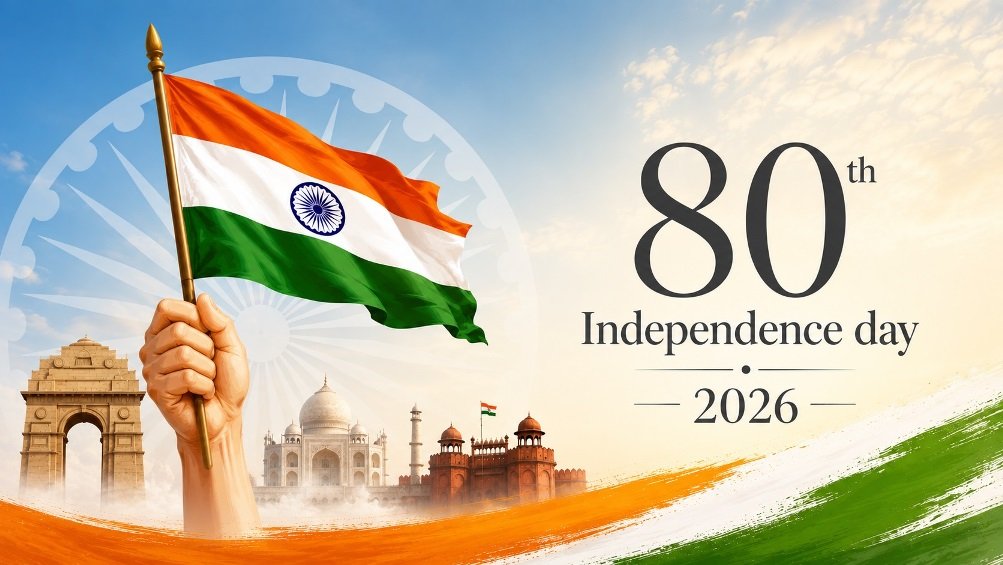
Every year on 15 August, India pauses to remember the journey that transformed the country from a British colony into an independent nation. On 15 August 2026, Indians will once again celebrate Independence Day, but this year carries a small historical distinction that is worth understanding.
India became independent on 15 August 1947. Therefore, 15 August 2026 marks 79 years of India’s independence. At the same time, the country will celebrate its 80th Independence Day.
The difference may sound confusing, but both descriptions can be correct: India is completing 79 years of freedom while celebrating the 80th occasion of Independence Day.
Why Is 15 August So Important?
Independence Day is not simply another national holiday.
It represents the end of nearly two centuries of British colonial rule and the beginning of India’s journey as a sovereign nation.
At midnight on 14–15 August 1947, India became independent. Jawaharlal Nehru, India’s first Prime Minister, delivered his historic “Tryst with Destiny” speech as the country stepped into a new era.
For millions of Indians, independence represented something much bigger than a change of government. It meant the possibility of determining India’s own future.
79 Years of India’s Independence
The journey from 1947 to 2026 has been filled with enormous changes.
India has transformed from a newly independent country facing poverty, food shortages, low industrialisation and the enormous challenge of integrating a diverse population into one nation.
Today, India is one of the world’s largest economies, has a major space programme, a rapidly expanding technology sector, a powerful entertainment industry and one of the world’s largest democratic electoral systems.
But the journey has never been perfect.
India has also faced wars, economic crises, communal tensions, political upheavals, natural disasters and social inequalities.
That is what makes Independence Day important. It is not only a celebration of how far the country has come, but also an opportunity to ask how much further it needs to go.
Why 15 August 2026 Matters
The 79th anniversary of India’s independence provides an opportunity to look at both India’s achievements and its unfinished goals.
The country has made remarkable progress in areas such as:
- Technology and digital payments
- Space exploration
- Infrastructure
- Manufacturing
- Education
- Healthcare
- Entrepreneurship
- Renewable energy
At the same time, challenges remain.
Access to quality education, employment opportunities, rural development, pollution, inequality and social harmony continue to demand attention.
Independence is therefore not something that belongs only to history. It also comes with the responsibility to build a better country for the next generation.
The Meaning of Freedom Has Changed
For people who lived through 1947, freedom meant independence from colonial rule.
For today’s generation, the meaning of freedom is broader.
It can mean the freedom to receive a good education, choose a career, express an opinion, start a business, live with dignity and participate in the country’s democratic process.
The India of 2026 is very different from the India of 1947, and the aspirations of its citizens have changed with it.
The challenge is to ensure that the benefits of India’s progress reach people across cities, towns and villages.
Remembering the Freedom Fighters
Independence Day is also a day to remember the countless people who contributed to India’s freedom struggle.
Names such as Mahatma Gandhi, Subhas Chandra Bose, Bhagat Singh, Sardar Vallabhbhai Patel, Sarojini Naidu, Chandrashekhar Azad, Rani Lakshmibai and many others have become permanent parts of India’s history.
But the freedom struggle was not carried by famous leaders alone.
Millions of ordinary Indians participated in protests, movements, boycotts and resistance. Many sacrificed their livelihoods, freedom and even their lives.
Remembering them is an important part of the celebration.
Why the Red Fort Tradition Matters
Every Independence Day, the Prime Minister addresses the nation from the Red Fort in New Delhi.
The ceremony has become one of India’s most recognisable national traditions.
The Prime Minister unfurls the national flag and addresses the country, reflecting on India’s achievements and discussing its future priorities.
For millions of Indians watching from home, the Red Fort ceremony has become an essential part of the morning of 15 August.
Independence Day Is Also About the Future
It is easy to think of Independence Day as a day to look backward.
But perhaps its greater purpose is to look forward.
The generation that fought for independence imagined a free India. Every generation since then has inherited the responsibility of deciding what that freedom should achieve.
For today’s young Indians, that responsibility includes creating jobs, developing new technologies, protecting the environment, respecting diversity and strengthening the institutions that keep democracy functioning.
The next chapter of India’s story will be written by them.
79 Years Later, What Does Independence Mean to You?
After 79 years, India has travelled an extraordinary distance.
But independence is not a destination that a country reaches once and then forgets about. It is something that has to be protected and strengthened by every generation.
So, on 15 August 2026, as the tricolour rises across the country, the celebration can be about more than remembering 1947.
It can also be about asking a simple question:
What kind of India do we want to build during the next 79 years?
That may be the most meaningful way to celebrate India’s Independence Day.
Happy Independence Day, India. 🇮🇳