India has a long history of protests. Long before social media, television debates and hashtags, people took to the streets, organised marches, refused to cooperate with authorities and sometimes put their lives at risk to demand change.
Some protests changed laws. Some brought down political systems. Others became turning points in India’s freedom struggle.
From the Revolt of 1857 to the Non-Cooperation Movement, Quit India Movement, JP Movement, anti-corruption protests and farmers’ protests, India’s history can also be understood through the movements that brought ordinary people together.
Here is a look at some of the most important protests and mass movements in Indian history.
Protests in India Before Independence
India’s protest history didn’t begin with Mahatma Gandhi.
Farmers, workers, tribal communities and rulers had already resisted British policies in different parts of the country.
The Sanyasi-Fakir Rebellion
During the late 18th century, groups of sanyasis and fakirs resisted the East India Company’s economic policies in parts of Bengal.
The movement is often considered one of the early forms of resistance to British rule.
It was not a single, centrally organised national movement, but it demonstrated the growing resentment against colonial economic control.
The Revolt of 1857
The Revolt of 1857 was one of the most important early uprisings against British rule.
The immediate trigger was the controversy surrounding the new Enfield rifle cartridges, but the rebellion had much deeper political, economic and military causes.
Indian soldiers, rulers, peasants and other groups participated in different parts of the uprising.
Delhi, Kanpur, Lucknow, Jhansi and several other regions became major centres of resistance.
Although the revolt was eventually suppressed, it fundamentally changed British policy in India.
The East India Company’s rule ended, and the British Crown took direct control of India in 1858.
The Swadeshi Movement
The partition of Bengal in 1905 triggered another major wave of protest.
The Swadeshi Movement encouraged Indians to boycott British goods and promote Indian-made products.
It wasn’t simply a political protest.
It became a social and economic movement involving students, intellectuals, businessmen, workers and ordinary citizens.
Boycotting foreign cloth and supporting Indian industries became powerful symbols of resistance.
Gandhi and the Transformation of Indian Protest
Mahatma Gandhi introduced a different style of mass political action.
His methods included non-violence, civil disobedience, boycotts and non-cooperation.
The idea was to challenge an unjust system without relying primarily on physical violence.
His earlier experiments with mass movements in India helped develop a form of protest that could involve millions of people.
Champaran Satyagraha – 1917
One of Gandhi’s first major movements in India was the Champaran Satyagraha.
Farmers in Bihar were facing oppressive conditions under the colonial indigo cultivation system.
Gandhi’s intervention brought national attention to their problems.
It became an important early example of how organised non-violent resistance could challenge colonial authority.
Kheda Satyagraha – 1918
In Gujarat, farmers facing crop failures and financial hardship protested against the collection of land revenue.
Gandhi and other leaders supported the farmers.
The movement strengthened the idea that ordinary people could collectively challenge government policies.
Non-Cooperation Movement – 1920–22
The Non-Cooperation Movement transformed the freedom struggle into a mass movement.
People were encouraged to boycott British institutions, schools, courts and goods.
Students left government institutions.
Lawyers gave up legal practices.
Foreign cloth was boycotted.
The movement attracted millions of Indians.
However, Gandhi suspended it after the Chauri Chaura incident in 1922, when protesters attacked a police station and policemen were killed.
The decision showed Gandhi’s insistence on maintaining non-violence as the foundation of his movement.
The Salt March – 1930
Few protests in Indian history are as iconic as the Dandi March.
The British government had imposed a tax and monopoly on salt.
Gandhi chose salt because it affected everyone, regardless of wealth or social status.
In March 1930, Gandhi began walking from Sabarmati Ashram with a group of followers toward Dandi on the Gujarat coast.
After travelling roughly 390 kilometres, he broke the salt law by making salt at the coast.
The protest sparked civil disobedience across India.
The image of Gandhi walking toward the sea became one of the defining images of India’s independence movement.
Quit India Movement – 1942
The Quit India Movement was launched by the Indian National Congress in August 1942.
The message was direct:
The British should leave India.
Gandhi gave his famous call of “Do or Die.”
British authorities quickly arrested major Congress leaders.
But the movement continued through strikes, demonstrations, underground networks and other forms of resistance.
The Quit India Movement became one of the largest mass movements against British rule.
Five years later, India became independent.
Protests Around Independence
India’s independence in 1947 did not end protest politics.
The newly independent country faced enormous challenges, including poverty, linguistic divisions, land issues and demands for greater political representation.
Mass movements continued to shape Indian democracy.
The Telangana Rebellion
Between the 1940s and early 1950s, peasants in the Hyderabad region participated in an armed rebellion against feudal landlords and the Nizam’s system.
The Telangana Rebellion became an important chapter in India’s history of agrarian movements and left-wing politics.
It also highlighted the deep inequalities that existed in rural India after independence.
The Language Movements
Language has been one of the most powerful causes of protest in independent India.
The anti-Hindi agitations in Tamil Nadu, particularly during the 1960s, were major political movements.
Protesters opposed attempts to increase the dominance of Hindi in administration and education.
The movements had a lasting impact on Indian language policy and Tamil Nadu politics.
They also demonstrated how regional identity could become a powerful force in democratic politics.
The JP Movement – 1974
In the 1970s, India witnessed another major student-led movement.
Students in Bihar protested against inflation, unemployment and corruption.
Socialist leader Jayaprakash Narayan, popularly known as JP, eventually became the face of the broader movement.
The movement called for what JP described as “Total Revolution”—a transformation of politics and society.
The political crisis eventually contributed to the declaration of the Emergency in 1975.
The Emergency itself remains one of the most controversial periods in independent India’s democratic history.
Anti-Sikh Riots and Protests in the 1980s
The 1980s saw several protests and movements shaped by religious, regional and political tensions.
The Nellie massacre, anti-Sikh violence following Indira Gandhi’s assassination, and various regional movements reflected the serious social tensions India was facing.
These episodes also demonstrate that India’s protest history isn’t always about successful democratic movements.
Sometimes protests and mass mobilisation can become deeply violent, with devastating consequences.
The Mandal Commission Protests – 1990
In 1990, the government’s decision to implement recommendations of the Mandal Commission triggered large protests, particularly among sections of students and young people.
The recommendations expanded reservations in government jobs for Other Backward Classes.
Supporters saw the policy as an important step toward social justice.
Opponents argued that it would reduce opportunities based on merit.
The protests, particularly in northern India, became one of the most significant political movements of the decade.
The debate over reservations continues to influence Indian politics today.
Narmada Bachao Andolan
The Narmada Bachao Andolan emerged around concerns over large dams being constructed on the Narmada river.
Activists, farmers and displaced communities argued that large development projects could cause displacement and environmental damage.
Medha Patkar became one of the best-known faces of the movement.
The movement brought questions about development, displacement, rehabilitation and environmental protection into national conversation.
Anti-Corruption Movement – 2011
In 2011, India witnessed one of the biggest protest movements of the social-media era.
Anna Hazare began a hunger strike demanding stronger anti-corruption legislation, particularly the proposed Lokpal system.
The movement quickly spread beyond Delhi.
Thousands of people gathered in cities across India.
Social media played a major role in mobilising supporters and spreading information.
The protests also helped create the political environment from which the Aam Aadmi Party emerged.
Nirbhaya Protests – 2012
The brutal gang rape and murder of a young woman in Delhi in December 2012 triggered massive protests across India.
Young people, students and citizens gathered in Delhi and other cities demanding stronger laws and better protection for women.
The protests became a national conversation about sexual violence, policing and women’s safety.
The government subsequently introduced significant changes to criminal law relating to sexual offences.
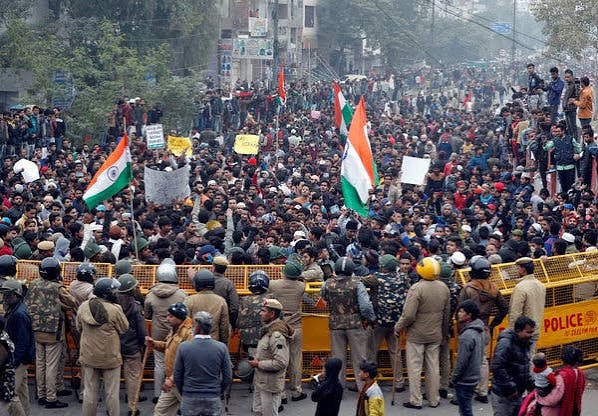
Anti-CAA Protests – 2019–20
The Citizenship Amendment Act (CAA) triggered widespread protests across India.
Opponents argued that the legislation discriminated on religious grounds and raised concerns about its relationship with citizenship and the proposed National Register of Citizens.
Supporters defended the law as a measure intended to provide citizenship to persecuted minorities from neighbouring countries.
The protests became particularly prominent at Shaheen Bagh in Delhi, where women led a prolonged sit-in.
The movement eventually became one of the largest protest campaigns in India in the years before the pandemic.
Farmers’ Protest – 2020–21
The farmers’ protest against three agricultural laws became one of the biggest sustained protest movements in recent Indian history.
Farmers, particularly from Punjab, Haryana and western Uttar Pradesh, travelled toward Delhi and established large protest camps around the capital.
They argued that the new farm laws could weaken the existing agricultural market system and leave farmers vulnerable to large corporations.
The government defended the laws as agricultural reforms intended to give farmers more options.
After months of protests, the government eventually announced the repeal of the three laws in 2021.
It became a powerful example of sustained democratic pressure leading to a major policy reversal.
Agnipath Protests – 2022
The government’s Agnipath military recruitment scheme triggered protests in several states in 2022.
Many young people objected to the proposed short-term nature of military service and concerns about future employment.
The protests included demonstrations and, in some places, violence and damage to public property.
The government subsequently announced several changes and incentives related to the scheme.
Protests in the Digital Age
Modern Indian protests look very different from those of the 20th century.
A protest can now begin with a social-media post and become a national movement within hours.
Hashtags, Instagram posts, YouTube videos, WhatsApp groups and livestreams have become important tools for mobilisation.
But digital activism also has its problems.
Misinformation can spread rapidly.
Old photographs can be presented as new.
Videos can be taken out of context.
And online outrage doesn’t always translate into sustained action on the ground.
Why Do Indians Protest?
The reasons have changed over time, but some themes appear repeatedly.
Economic hardship.
Unemployment.
Land and agricultural issues.
Corruption.
Identity and language.
Environmental concerns.
Government policies.
Social justice.
Women’s safety.
Political representation.
In many cases, protests emerge when people feel that existing political or institutional channels aren’t adequately addressing their concerns.
Are Protests Important for Democracy?
In a democracy, protests can provide citizens with a way to publicly express disagreement.
Elections happen every few years.
Protests can happen tomorrow.
That doesn’t mean every protest is automatically right or every demand should be accepted.
A democratic protest still exists within a larger framework of rights, laws and responsibilities.
Peaceful assembly and freedom of expression are important democratic principles, while violence, destruction of property and threats against others raise very different questions.
From Gandhi’s Marches to Social Media Hashtags
The biggest change in India’s protest culture may be technology.
Gandhi walked hundreds of kilometres to make the Salt March impossible to ignore.
Today, a protest can reach millions of people before the protesters have even left their homes.
Yet the fundamental idea remains remarkably similar:
ordinary people trying to make their voices heard.
From the freedom struggle to farmers’ camps on the borders of Delhi, India’s history shows that public protest has repeatedly influenced the country’s political and social direction.
Some movements disappeared.
Some failed.
Some became violent.
And some changed India forever.