
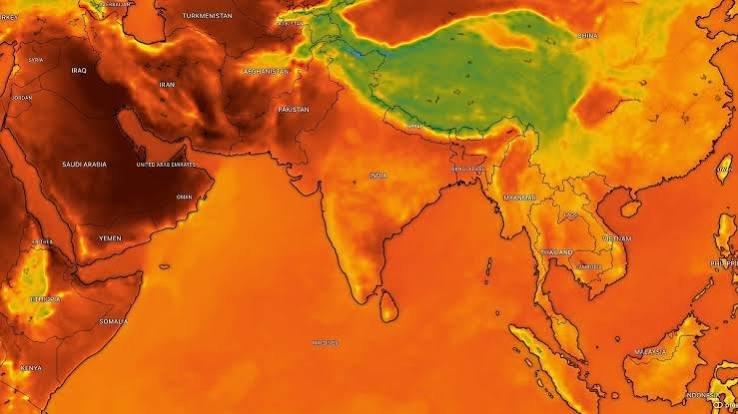
El Niño 2026 is becoming one of the biggest weather stories of the year, particularly for India.
The warming of the Pacific Ocean may sound like something happening thousands of kilometres away, but El Niño can influence rainfall, temperatures, agriculture and food prices across the Indian subcontinent.
This year, the concern is particularly important because climate agencies expect the El Niño event to strengthen considerably during the second half of 2026. The World Meteorological Organization has described a rapid development toward a strong El Niño, while the US Climate Prediction Center has put the probability of a very strong event later in 2026 at more than 90%.
So, what exactly is El Niño 2026 and how could it affect India?
What Is El Niño?
El Niño is a natural climate phenomenon associated with unusually warm sea-surface temperatures in the central and eastern tropical Pacific Ocean.
That warming changes atmospheric circulation and can disturb normal weather patterns around the world.
Its effects aren’t identical every year, but India has historically been particularly sensitive to El Niño because of its influence on the Southwest Monsoon.
The India Meteorological Department has already reported weak El Niño conditions over the equatorial Pacific and said models indicated that the conditions could strengthen during the 2026 monsoon season.
Why Is El Niño 2026 a Concern for India?
The biggest concern is rainfall.
India’s agriculture depends heavily on the monsoon, with the Southwest Monsoon providing roughly 70% of the country’s annual rainfall. Nearly half of India’s farmland is also without irrigation, making rainfall patterns extremely important for farmers.
El Niño generally increases the risk of weaker or irregular monsoon rainfall over India.
That doesn’t mean every part of India will automatically experience drought. Weather is influenced by several factors, including the Indian Ocean Dipole, Madden-Julian Oscillation and regional weather systems.
But a strong El Niño can increase the risk.
El Niño 2026 and the Indian Monsoon
The impact is already being closely watched.
India’s rainfall during the 2026 monsoon season was reported to be 12% below average as of August 11, with concerns that the deficit could increase as El Niño strengthens. The IMD has also warned about a weakening monsoon over western, central and southern parts of India in the coming weeks.
Earlier, the IMD had forecast below-average rainfall for August, after July rainfall was close to normal.
This is important because August and September are crucial months for many crops already planted during the monsoon.
What Could Happen to Indian Farmers?
Agriculture is likely to be among the sectors most exposed to El Niño.
A prolonged dry spell can affect crops such as:
- Rice
- Cotton
- Soybean
- Maize
- Pulses
- Sugarcane
Farmers who depend primarily on rainfall may face difficulties if rain becomes irregular during important stages of crop growth.
Recent reports have already highlighted concerns for crops including cotton, soybean, corn and pulses because of weaker rainfall in parts of the country.
The impact, however, won’t necessarily be the same everywhere. Some regions could receive adequate or even excessive rainfall despite a broader El Niño pattern.
Could El Niño Make Food More Expensive?
Potentially, yes.
If rainfall shortages reduce agricultural production, supplies of certain food items could tighten.
That can put upward pressure on prices of:
Vegetables → Pulses → Cereals → Edible oils → Other agricultural products
Food inflation is therefore one of the reasons economists are watching El Niño closely.
The International Monetary Fund has already identified a weaker monsoon influenced by El Niño as one of the risks to India’s economic growth in financial year 2026–27.
However, India enters this period with relatively strong food stocks in some important commodities, which could provide a buffer against a major supply shock.
El Niño 2026 Could Also Mean More Heat
El Niño doesn’t only affect rainfall.
It can contribute to higher temperatures globally, and the combination of El Niño and human-caused climate change can increase the risk of extreme heat.
The WMO has warned that El Niño is likely to influence global temperature and rainfall patterns and increase the risk of extreme weather during the coming months.
For India, that could mean greater pressure from heat on cities, agriculture, electricity demand and water resources.
What About Water Levels?
A weaker monsoon can affect India’s reservoirs, groundwater recharge and local water supplies.
This can become particularly important toward the end of the year and into the following summer.
Cities and states that depend heavily on monsoon rainfall for drinking water and agriculture could face greater pressure if rainfall remains below normal.
The effects can therefore continue long after the headline weather event has disappeared from the news.
Could El Niño Affect Electricity Bills?
It can indirectly.
Hotter weather increases the demand for air conditioning and cooling, which can increase electricity consumption.
At the same time, weak rainfall can affect hydropower generation in areas dependent on reservoirs.
If agricultural production is also affected, the economic consequences can spread to other sectors.
This doesn’t mean El Niño automatically causes electricity prices to rise, but it can create additional pressure on the energy system.
Will Every Part of India Be Affected?
No.
This is an important point.
El Niño is a global climate driver, not a weather forecast for every Indian city.
Its influence interacts with local weather systems and other ocean-atmosphere patterns.
The Indian Ocean Dipole, for example, can modify the relationship between El Niño and Indian rainfall. The IMD has been monitoring both ENSO and IOD conditions while assessing the monsoon.
Therefore, someone living in Mumbai, Delhi, Kolkata or Bengaluru may experience very different weather even during the same El Niño event.
Is El Niño 2026 Going to Be a “Super El Niño”?
This phrase is increasingly appearing in headlines, but it should be treated carefully.
Forecast agencies expect the event to become strong, and the US Climate Prediction Center has said there is a high probability of a very strong El Niño later in 2026. Reuters reported that there is also a 69% probability that October–December 2026 conditions could reach historic levels compared with El Niño events recorded since 1950.
But forecasts can change.
Calling it the strongest El Niño ever before the event reaches its peak would be premature.
What Can India Do?
India is much better prepared for weather shocks than it was several decades ago.
Improved irrigation, agricultural technology, weather forecasting, crop insurance, food stocks and digital farming advisories can all help reduce the damage.
Farmers can also benefit from timely weather information and adjustments in planting and irrigation decisions.
The country’s food stocks provide another layer of protection against a sudden shortage.
The bigger challenge is making sure these resources reach the people who need them.
The Bigger Picture
El Niño 2026 isn’t simply a story about rain.
It can influence agriculture, food prices, water availability, electricity demand, economic growth and everyday life.
India has experienced El Niño events before, so the phenomenon itself isn’t new.
What makes 2026 particularly important is the expected strength of the event and the fact that it is developing alongside a warming global climate.
For ordinary Indians, the most visible impact may simply be a hotter day or an unusually dry spell.
For farmers, businesses and policymakers, however, the consequences can be much bigger.
Final Takeaway
El Niño 2026 could put India’s monsoon under additional pressure, but it does not guarantee a nationwide drought.
The coming months will depend on how strong the El Niño becomes, how India’s monsoon evolves, and how other climate patterns interact with it.
For now, the message from weather agencies is clear: India needs to prepare for greater rainfall and temperature uncertainty rather than assume that every region will experience the same conditions.
And with the peak of El Niño expected later in 2026, this is a weather story that India will likely continue watching closely.